
AI vs traditional marketing advantages and differences
Marketing has always evolved alongside technology, culture, and consumer behavior. From newspaper advertisements and billboards to social media campaigns and predictive analytics, every generation of marketers has had to rethink how brands attract attention, build trust, and influence buying decisions.
This creates an important question for modern businesses: when comparing AI vs traditional marketing advantages and differences, which approach delivers better results?
The answer is not as simple as choosing one side. AI marketing offers speed, automation, personalization, and data-driven optimization. Traditional marketing offers broad visibility, physical presence, emotional familiarity, and established forms of communication. The right choice depends on the audience, business model, campaign objectives, available data, budget, and market conditions.
Understanding the strengths and limitations of both approaches can help businesses build smarter marketing strategies rather than simply following the latest trend.
What Is AI Marketing?
AI marketing refers to the use of artificial intelligence technologies to support, automate, analyze, and improve marketing activities. Instead of relying entirely on manual processes, marketers can use AI-powered systems to identify patterns, process customer data, predict possible outcomes, and make certain marketing activities more efficient.
AI can support many areas of modern marketing, including:
- Customer segmentation
- Predictive analytics
- Content ideation and production
- Email personalization
- Advertising optimization
- Lead scoring
- Chatbots and automated customer support
- Product recommendations
- Social media analysis
- Customer journey optimization
- Search behavior analysis
- Marketing performance reporting
For example, a traditional campaign may send the same promotional message to a large audience. An AI-supported campaign can potentially divide that audience into smaller groups based on behavior, interests, previous interactions, purchase history, or likelihood to convert.
This does not mean AI replaces marketing strategy. Technology can process information quickly, but businesses still need clear positioning, meaningful objectives, strong creative direction, accurate data, and human judgment.
What Is Traditional Marketing?
Traditional marketing generally refers to established marketing methods that existed before the rapid expansion of digital platforms and AI-powered tools. It often includes offline channels designed to reach broad or geographically defined audiences.
Common traditional marketing methods include:
- Television advertising
- Radio advertising
- Newspaper advertisements
- Magazine advertising
- Billboards
- Brochures
- Flyers
- Direct mail
- Event sponsorships
- Outdoor advertising
- In-store promotions
- Printed catalogs
Traditional marketing is sometimes described as outdated, but that is an oversimplification. A strategically placed billboard can still create powerful brand visibility. A radio campaign may work well for a regional business. A premium magazine placement can support brand positioning. An event sponsorship can create real-world engagement that is difficult to reproduce through an automated digital experience.
The effectiveness of traditional marketing depends on context.
AI vs Traditional Marketing: The Core Difference
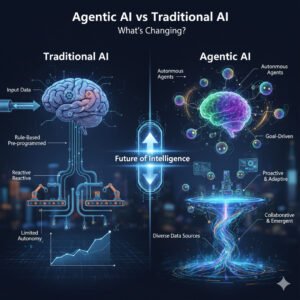
The most important difference between AI marketing and traditional marketing lies in how campaigns are planned, targeted, executed, measured, and improved.
Traditional marketing often relies on broader audience groups, scheduled campaign cycles, market research, creative development, and historical performance data. AI marketing can process larger datasets and continuously identify patterns that may help marketers adjust campaigns more quickly.
In simple terms, traditional marketing often asks:
“Which message should we deliver to this audience?”
AI-supported marketing can go further:
“Which message is most relevant to this specific audience segment, through which channel, at what stage of the customer journey, and based on which behavioral signals?”
This difference affects nearly every aspect of marketing performance.
1. Data Analysis and Decision-Making
One of the clearest advantages of AI marketing is its ability to process large volumes of data.
Traditional marketers have always used data. Market research, customer surveys, sales reports, demographic studies, and campaign performance reviews are not new. However, analyzing complex datasets manually can be time-consuming.
AI-powered systems can help identify patterns across multiple variables and large datasets much faster. This can support decisions related to audience behavior, campaign timing, customer segmentation, conversion probability, and content performance.
The key difference is not that traditional marketing ignores data. The difference is the scale and speed at which AI can process information.
However, AI output is only as useful as the data and assumptions behind it. Poor-quality data can produce misleading recommendations. Human oversight remains essential.
2. Personalization
Personalization is one of the strongest AI marketing advantages.
Traditional campaigns are often designed for broad audience categories. A television commercial may target families. A magazine advertisement may target business professionals. A billboard may target commuters in a specific area.
AI marketing can support much more detailed segmentation.
A business may personalize experiences according to:
- Previous purchases
- Browsing behavior
- Product interests
- Engagement history
- Customer lifecycle stage
- Geographic context
- Response to earlier campaigns
- Predicted preferences
This can make marketing communication more relevant.
For example, two customers visiting the same e-commerce platform may receive different product recommendations based on their previous behavior. Two email subscribers may receive different offers depending on their engagement history.
Traditional marketing usually cannot provide this level of individualization at scale.
3. Speed and Automation
Marketing teams often spend significant time on repetitive activities. These may include organizing data, preparing reports, categorizing leads, testing variations, scheduling communications, or responding to common customer questions.
AI can automate parts of these workflows.
This may help teams:
- Reduce repetitive manual work
- Analyze campaign data faster
- Generate initial content ideas
- Identify unusual performance patterns
- Prioritize leads
- Personalize communications
- Support faster testing
Traditional marketing usually involves longer production cycles. A print advertisement must be designed, approved, produced, and distributed. A billboard may remain unchanged for weeks. A television commercial may require significant production resources.
AI-supported digital marketing can often move faster.
However, speed should not be confused with quality. Producing more content or launching more campaign variations does not automatically improve marketing performance. Strategic relevance remains more important than volume.
4. Audience Targeting
Traditional marketing often targets audiences through broad characteristics such as location, publication readership, television programming, or general demographics.
AI marketing can use more detailed behavioral signals.
This may include:
- Search behavior
- Website activity
- Purchase patterns
- Content engagement
- Product preferences
- Customer value
- Conversion likelihood
As a result, AI-supported targeting can potentially reduce wasted exposure and improve relevance.
Yet broader reach still has value. A company launching a new mass-market product may benefit from television, outdoor advertising, or sponsorship. Not every campaign should focus only on narrow audience segments.
5. Campaign Optimization
Traditional campaigns are often evaluated at specific intervals. Marketers may review results after a campaign has run for several days, weeks, or months.
AI-supported marketing can help teams identify changes more quickly.
For example, systems may detect:
- Declining engagement
- Changes in conversion behavior
- Audience fatigue
- Strong-performing segments
- Weak-performing creative variations
- Shifts in customer demand
This can support faster optimization.
The advantage is especially important in performance marketing environments where costs, competition, and user behavior can change rapidly.
Still, marketers should avoid blindly following automated recommendations. A short-term performance improvement may conflict with long-term brand positioning. Human judgment is needed to understand the broader business context.
6. Cost Efficiency
The cost comparison between AI and traditional marketing depends heavily on the campaign.
Traditional marketing can involve significant expenses related to:
- Media buying
- Printing
- Physical production
- Distribution
- Television production
- Outdoor placements
- Event participation
AI-supported marketing may reduce some operational costs by automating tasks and improving targeting.
For smaller businesses, AI tools can also make certain capabilities more accessible. A small team may use technology for reporting, research support, customer segmentation, or workflow automation without hiring a large department for every task.
However, AI is not automatically cheap. Advanced systems may require:
- Software subscriptions
- Technical integration
- Data infrastructure
- Skilled professionals
- Training
- Governance
- Ongoing monitoring
Therefore, businesses should evaluate total value rather than assuming AI always reduces costs.
7. Measurement and Attribution
Traditional marketing measurement can be challenging.
How many people saw a billboard and later purchased a product? How many customers visited a store because of a radio advertisement? How much influence did a magazine campaign have on brand perception?
These questions can be difficult to answer precisely.
AI-supported digital marketing can often provide more detailed performance signals, such as:
- Clicks
- Conversions
- Engagement
- Customer acquisition patterns
- Funnel behavior
- Revenue contribution
- Audience segment performance
AI can also help analyze complex customer journeys.
However, attribution is still not perfect. Customers interact with multiple channels before making decisions. A person may see a billboard, search for the brand later, read reviews, watch a video, and finally purchase after receiving an email.
For this reason, marketers should avoid treating one data source as the complete truth.
8. Creativity and Human Understanding
This is where the comparison becomes more complex.
AI can support creativity by generating ideas, identifying patterns, suggesting variations, summarizing research, or accelerating early-stage production. But human creativity is connected to lived experience, cultural understanding, emotional nuance, intuition, humor, timing, and context.
A powerful campaign is not always the one that follows the most predictable pattern.
Some of the strongest marketing ideas succeed because they challenge expectations, capture a cultural moment, express a distinctive point of view, or communicate an emotion that audiences recognize immediately.
Traditional marketing has historically relied heavily on human creative teams, strategists, copywriters, designers, directors, researchers, and brand leaders.
The future is unlikely to be purely human or purely automated. The more practical model is collaboration: AI can accelerate certain tasks while people provide judgment, originality, strategic direction, and accountability.
Key Advantages of AI Marketing
When evaluating AI vs traditional marketing advantages and differences, the benefits of AI become especially clear in data-rich and fast-moving environments.
The main advantages include:
- Faster analysis of large datasets
- Greater personalization at scale
- Automation of repetitive tasks
- More detailed audience segmentation
- Faster campaign optimization
- Predictive capabilities
- Efficient testing of multiple variations
- Better support for real-time decision-making
- Improved customer journey analysis
- Scalable marketing operations
These advantages can be particularly valuable for e-commerce businesses, digital platforms, subscription services, online retailers, and organizations managing large customer databases.
Key Advantages of Traditional Marketing
Traditional marketing also offers important strengths that should not be ignored.
Its main advantages include:
- Broad mass-market reach
- Strong local visibility
- Physical brand presence
- Familiarity among certain audiences
- Potential credibility from established media channels
- Strong impact for large awareness campaigns
- Effective integration with events and sponsorships
- Ability to reach less digitally active audiences
For some industries, traditional media remains highly relevant. Automotive brands, real estate companies, retailers, financial institutions, hospitality businesses, and large consumer brands may benefit from combining offline and online channels.
AI Marketing vs Traditional Marketing: A Practical Comparison
1.Targeting
AI marketing supports detailed, behavior-based segmentation.
Traditional marketing often relies on broader demographic, geographic, or media-based targeting.
2.Personalization
AI can personalize experiences for different users and customer segments.
Traditional marketing usually delivers one message to a broader audience.
3.Speed
AI-supported campaigns can often be analyzed and adjusted quickly.
Traditional campaigns may require longer production and revision cycles.
4.Measurement
AI and digital systems can provide detailed performance data.
Traditional marketing can be more difficult to attribute directly to specific conversions.
5.Reach
Traditional media can create strong mass awareness.
AI marketing often performs best when targeting specific audiences or optimizing digital journeys.
6.Creativity
AI can accelerate ideation and production.
Human-led marketing remains essential for cultural understanding, emotional depth, originality, and brand judgment.
7.Cost
AI may improve efficiency but can require investment in tools, data, integration, and expertise.
Traditional marketing can involve substantial production and media placement costs.
Is AI Better Than Traditional Marketing?
AI is not automatically better than traditional marketing.
A better question is: which approach is more suitable for a specific business objective?
If a company wants to personalize product recommendations for thousands of customers, AI may offer a clear advantage.
If a local business wants strong visibility in a specific physical area, outdoor advertising may be effective.
If a brand wants to optimize paid campaigns continuously, AI-supported analysis can be valuable.
If a major company wants nationwide awareness, television and outdoor media may still play an important role.
Marketing effectiveness depends on strategic fit.
Why a Hybrid Marketing Strategy Often Works Best
For many businesses, the strongest solution is not AI versus traditional marketing. It is AI combined with traditional marketing.
A hybrid strategy can use the strengths of each approach.
For example, a company might:
- Launch a broad awareness campaign through outdoor media
- Use digital campaigns to capture interested audiences
- Apply AI to segment leads
- Personalize follow-up communication
- Analyze campaign performance
- Use human strategists to interpret results
- Refine brand messaging based on market response
This creates a connected marketing ecosystem.
The traditional campaign builds awareness. Digital channels capture demand. AI improves analysis and personalization. Human expertise ensures that the entire strategy remains aligned with business goals.
The Risks of Relying Too Heavily on AI
AI marketing offers major opportunities, but businesses should also understand its limitations.
1.Poor Data Quality
AI systems depend on data. Inaccurate, incomplete, outdated, or biased data can lead to weak decisions.
2.Loss of Brand Distinctiveness
If many companies rely on similar tools and prompts, their content may begin to sound alike. Brand voice can become generic.
3.Over-Automation
Customers may become frustrated when every interaction feels automated. Human support remains important, particularly in complex or sensitive situations.
4.Privacy Concerns
Personalization must be managed responsibly. Businesses need to consider consent, data protection, transparency, and relevant regulations.
5.Lack of Context
AI may identify correlations without fully understanding cultural, emotional, political, or strategic context.
6.Dependence on Technology
Marketing teams that automate too much may lose important internal skills. Technology should strengthen expertise rather than eliminate critical thinking.
How Businesses Can Choose the Right Approach
Before choosing between AI marketing and traditional marketing, businesses should ask several questions.
1.What Is the Main Objective?
Brand awareness, lead generation, customer retention, sales growth, market entry, and reputation building require different strategies.
2.Who Is the Target Audience?
A digitally active audience may respond well to personalized digital experiences. Other audiences may still engage strongly with television, radio, print, or outdoor media.
3.What Data Is Available?
AI becomes more valuable when businesses have relevant, reliable, and responsibly collected data.
4.How Complex Is the Customer Journey?
Long or multi-stage buying journeys may benefit from advanced analysis and personalization.
5.What Is the Budget?
The right strategy should consider both media costs and the resources required for implementation.
6.What Internal Skills Exist?
Technology alone does not create marketing success. Businesses need people who understand strategy, customers, data, creativity, and execution.
The Future of AI and Traditional Marketing
The future of marketing is unlikely to involve the disappearance of traditional methods. Instead, the boundaries between traditional, digital, and AI-powered marketing will continue to become less rigid.
A billboard may generate online searches. A television advertisement may drive social media conversations. An event may produce digital leads. AI may analyze responses across multiple touchpoints.
The most competitive businesses will likely focus less on labels and more on integration.
They will ask:
- Where does our audience spend attention?
- Which channels build trust?
- What creates demand?
- What drives measurable action?
- Where can automation improve efficiency?
- Where is human judgment essential?
AI will continue to transform how marketers analyze information and manage complexity. But strategy, positioning, creativity, trust, and customer understanding will remain fundamental.
What is the main difference between AI marketing and traditional marketing?
The main difference is how data, targeting, personalization, and optimization are handled. AI marketing can analyze large datasets, automate tasks, and personalize communication at scale. Traditional marketing often uses broader audience targeting through channels such as television, radio, print, and outdoor advertising.
What are the biggest advantages of AI in marketing?
The biggest advantages include faster data analysis, personalization, automation, predictive insights, detailed audience segmentation, and faster campaign optimization.
Is traditional marketing still effective?
Yes. Traditional marketing can still be effective for mass awareness, local visibility, physical brand presence, sponsorships, and reaching audiences that engage strongly with offline media.
Can AI replace marketing professionals?
AI can automate and accelerate many tasks, but it does not remove the need for human strategy, judgment, creativity, cultural understanding, leadership, and accountability. Marketing professionals remain essential for defining objectives and interpreting context.
Is AI marketing cheaper than traditional marketing?
Not always. AI can improve efficiency and reduce some manual work, but advanced implementation may require software, integration, data infrastructure, skilled professionals, and ongoing monitoring.
Which businesses benefit most from AI marketing?
Businesses with large amounts of customer data, frequent digital interactions, multiple audience segments, or high campaign volumes may benefit significantly. Examples include e-commerce companies, digital platforms, subscription businesses, and large retailers.
Can small businesses use AI marketing?
Yes. Small businesses can use AI for tasks such as research support, content planning, email segmentation, customer service automation, reporting, and campaign analysis. The key is to choose tools that solve real business problems rather than adopting technology without a clear purpose.
Should a business choose AI marketing or traditional marketing?
The decision should depend on the audience, objectives, budget, customer journey, available data, and market. In many cases, a hybrid strategy produces stronger results than relying exclusively on one approach.
Final Thoughts
The debate around AI vs traditional marketing advantages and differences should not be reduced to a simple competition between new technology and old methods.
AI marketing offers speed, scale, personalization, automation, and advanced data analysis. Traditional marketing offers broad visibility, physical presence, established communication channels, and powerful opportunities for mass awareness.
The strongest marketing strategies are built around business objectives, not trends.
A company should not use AI simply because AI is popular. It should not continue investing in traditional channels simply because they worked in the past. Every channel, tool, and technology should have a clear strategic role.
For many businesses, the most effective path is integration: use AI where it improves analysis, efficiency, personalization, and optimization; use traditional marketing where it strengthens reach, awareness, credibility, and real-world visibility; and keep experienced human judgment at the center of strategic decisions.
If you want to build a smarter marketing strategy that combines data, technology, performance, and practical business insight, explore the marketing expertise available through Walaa ElAmin. To discuss your business objectives and identify the right approach for sustainable growth, Contact today.