
Is AI Search Replacing Traditional SEO? The Future of Search in the Age of Artificial Intelligence
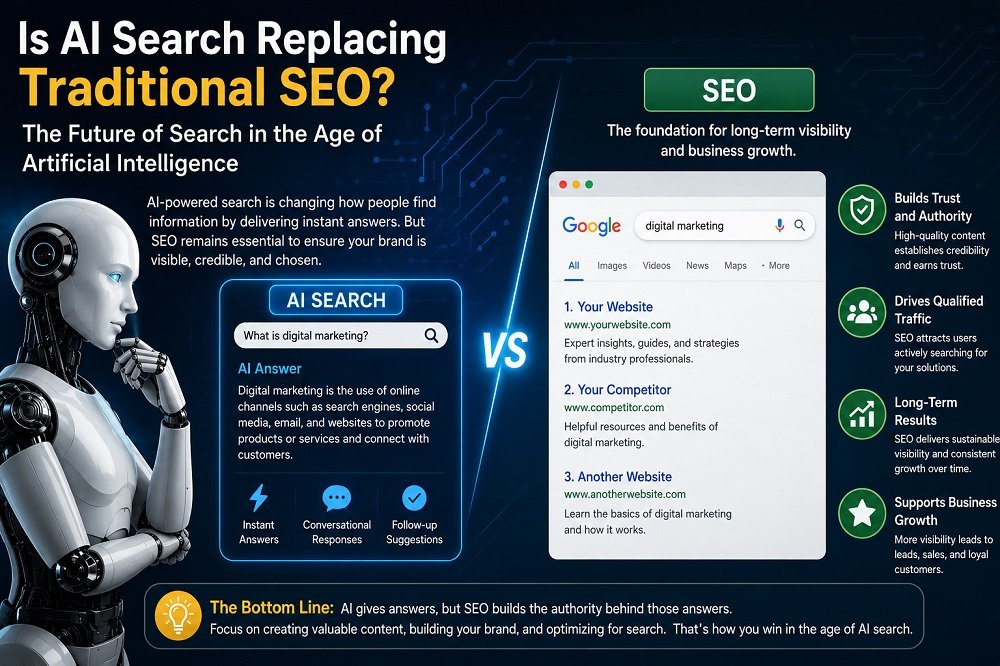
Is AI Search replacing traditional SEO?
The answer is more complex than a simple yes or no. While artificial intelligence is undoubtedly transforming how people search for information online, SEO remains an essential part of digital visibility. What is changing is the way search engines deliver information and how websites must position themselves to remain relevant.
Understanding this shift is critical for businesses that want to maintain their online presence and continue generating traffic, leads, and sales in the years ahead.
The Evolution of Search Behavior
Traditional search engines were built around a straightforward process. Users entered a query, received a list of search results, and clicked on the website they believed would provide the best answer.
For years, success in SEO depended largely on ranking as high as possible for targeted keywords. The higher a page ranked, the more traffic it typically received.
Today, that process is evolving.
Artificial intelligence is enabling search engines to understand user intent more effectively and provide immediate answers directly within search results. Instead of requiring users to visit multiple websites to gather information, AI-powered search experiences can summarize relevant information and present it in a conversational format.
This change significantly reduces the effort required from users while creating new challenges and opportunities for website owners.
Why AI Search Is Changing the Digital Landscape
The primary goal of search engines has always been to help users find answers quickly and accurately. Artificial intelligence simply allows search engines to achieve this goal more efficiently.
Modern AI-powered search experiences can:
- Summarize information from multiple sources.
- Answer complex questions.
- Provide conversational responses.
- Generate follow-up suggestions.
- Help users complete tasks faster.
From a user perspective, these developments improve convenience and save time.
From a business perspective, however, the shift raises concerns about declining website traffic and reduced click-through rates for certain types of content.
If users can find answers directly within search results, they may have less reason to visit the original website.
This reality is forcing marketers to rethink traditional SEO strategies and focus more heavily on creating content that offers genuine value beyond simple answers.
Is SEO Really Dying?
Despite the growing popularity of AI-powered search, claims that SEO is dying are greatly exaggerated.
Search engines still rely on websites as their primary sources of information. Artificial intelligence does not generate knowledge independently; it analyzes, organizes, and presents information that already exists across the web.
Without high-quality websites producing valuable content, AI systems would have no reliable information to reference.
In many ways, SEO is becoming more important than ever. The difference is that search engines are becoming more selective about which sources they trust and prioritize.
The websites that succeed in the future will not necessarily be those producing the highest volume of content. Instead, success will belong to businesses that consistently demonstrate expertise, authority, and trustworthiness.
The Content Most Affected by AI Search
Not all content is impacted equally by the rise of AI-generated answers.
Informational content that provides basic definitions or generic explanations is often the most vulnerable. Articles that simply answer straightforward questions can be summarized easily within search results.
Examples include:
- What is digital marketing?
- What is SEO?
- How does social media marketing work?
- What is content marketing?
These topics are important, but they are also widely covered across thousands of websites.
When content offers little originality, AI systems can often deliver the core answer without requiring users to visit the source website.
As a result, many publishers are already seeing changes in traffic patterns for broad informational keywords.
The Types of Content That Continue to Thrive
While some content categories face increasing competition from AI-generated answers, others remain highly valuable.
Expert-Led Content
Articles written by industry professionals often provide unique insights that cannot be easily replicated by AI systems.
Expert opinions, strategic recommendations, and professional analysis continue to attract users because they offer perspectives rather than simple facts.
Original Research and Data
Unique studies, surveys, reports, and industry benchmarks provide information unavailable elsewhere.
Since AI systems depend on existing information, original research remains one of the strongest ways to establish authority and attract citations.
Case Studies
Real-world examples and documented business results offer valuable lessons that users actively seek.
Case studies demonstrate credibility while providing practical evidence that supports recommendations and strategies.
Service Pages
Users searching for professional services are often evaluating providers rather than looking for simple answers.
These visitors typically need detailed information about expertise, experience, pricing, and capabilities before making a decision.
Product and E-Commerce Content
AI can summarize product information, but customers still need to compare options, view specifications, read reviews, and complete purchases.
For this reason, product-focused websites continue to play a critical role within the customer journey.
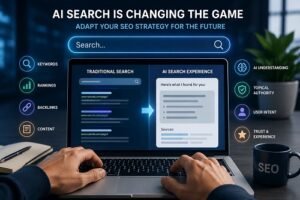
The Growing Importance of Brand Authority
One of the most significant changes in the AI era is the increasing value of brand authority.
Search engines want to provide users with accurate and trustworthy information. As a result, they are more likely to reference organizations and individuals that have established credibility within their industries.
Businesses that invest in brand development gain several advantages:
- Greater visibility across search platforms.
- Higher levels of trust.
- Stronger customer loyalty.
- Increased brand recognition.
- Better opportunities to be cited by AI systems.
Building a recognizable brand is no longer a branding exercise alone. It has become a critical SEO strategy.
Why E-E-A-T Matters More Than Ever
Google’s concept of Experience, Expertise, Authoritativeness, and Trustworthiness has become increasingly relevant in today’s search environment.
As AI-powered systems evaluate content quality, signals related to expertise and credibility play a larger role in determining which sources deserve visibility.
Businesses can strengthen E-E-A-T by:
- Publishing content written by qualified professionals.
- Demonstrating real-world experience.
- Including author information.
- Referencing credible sources.
- Maintaining transparent business information.
- Showcasing customer success stories.
Trust is becoming one of the most valuable assets a website can possess.
How Businesses Should Adapt Their SEO Strategy
The future of SEO is not about abandoning traditional optimization techniques. Instead, it involves expanding those techniques to align with evolving search behavior.
Businesses should focus on:
Creating Original Content
Content should provide unique perspectives, practical insights, and valuable information that users cannot find elsewhere.
Investing in Thought Leadership
Publishing expert opinions and industry analysis helps establish authority and differentiate a brand from competitors.
Using Structured Data
Schema markup helps search engines understand content more effectively and may improve visibility across AI-powered search experiences.
Building Multi-Channel Visibility
Strong brands are present across websites, social media, email marketing, video platforms, and industry publications.
Visibility beyond search engines contributes to overall authority.
Developing Comprehensive Resource Content
Detailed guides, tutorials, comparisons, and educational resources continue to attract both users and search engines.
The Future of SEO and AI Search
The relationship between SEO and artificial intelligence should not be viewed as a competition. Instead, AI search represents the next evolution of how information is discovered and delivered.
Search engines still need reliable sources. Businesses still need visibility. Customers still need trusted information before making decisions.
The difference is that the standards for earning visibility are becoming higher.
Organizations that focus on publishing high-quality content, demonstrating expertise, and building strong brands will continue to benefit from search traffic regardless of technological changes.
Rather than asking whether SEO is dead, businesses should ask a more important question:
How can we become the trusted source that AI systems choose to reference?
The companies that answer this question successfully will be the ones that thrive in the future of search.
Artificial intelligence is undoubtedly changing the search landscape, but it is not eliminating the need for SEO. Instead, it is rewarding quality, originality, expertise, and trust more than ever before.
Businesses that continue relying on outdated tactics such as keyword stuffing, low-quality content, and mass-produced articles may struggle to maintain visibility.
Those that invest in authority, experience, and meaningful content will not only survive the transition but also position themselves as industry leaders in the age of AI-powered search.
The future belongs to brands that create information worth citing, sharing, and trusting. In a world where AI can answer questions instantly, becoming the source behind those answers may be the most valuable SEO strategy of all.